Showing posts with label Travelogue. Show all posts

11 July 2017

The Place to Take Children in Portland that You Haven't Thought Of

I've had occasion recently to visit a couple of shiva houses and I've been thinking of King Solomon's statement (Koheles 7:2) that it's better to visit a house of mourning than one of feasting. I was kind of reluctant to visit the first one -- "I am going so the mourner can talk about the person who passed away but others there are going to make small talk, it's a long walk, it's raining, there's a lion in the road, do I HAVE TO??" and yes, yes I did, so I went; and I was glad I did; the mourner was telling stories about her mother, and what it is like when someone passes away, and what it's like for the family, and it was a meaningful experience for all of us.

Fast forward to a recent trip to Portland.
My mother proposed that we ride the tram that flies across the city on a cable, which was built ten years ago to transport hospital staff from one OHSU campus to another. The ride is a few minutes long and quite beautiful, and we all enjoyed it, although Loops thought it would be more like a roller coaster and said she thought it ought to bump a little more. You can see all the mountains, even Mt. Adams; and I noticed for the first time that Portland's Mt. Tabor closely resembles the original Har Tavor in Israel; and the area below the tram is the old turn-of-the-century Jewish neighborhood of Portland, which is nice to look down on; and if you, reader, are wondering along with everyone else who rides the tram what the big round building you passed on the OHSU tram is, I can tell you: it's a synagogue built by Jews from the Isle of Rhodes, still in occasional use and known affectionately to the community as "the beehive."

Once we got off the tram we stayed in the station for another cycle to watch how the mechanism works (I'm glad we rode it before I saw that the whole thing boils down to just three wires - it's very elegant) and then we discovered that a set of stairs leads down from the tram to other parts of the hospital.
The best banister to slide down in Portland is the one in the Hilton hotel downtown; the second banister disappeared in a remodeling years ago and the third (the Keller Auditorium) and fourth (the Arlene Schnitzer) are nothing too out of the common; so I am pleased to tell you that the new banisters up at the OHSU tram station are almost as good as the one at the Hilton, better than any other banisters in town for sliding down.

Should you be weighing the merits of taking children for a ride on the tram (and down the banisters), the factor you haven't considered is that the tram station was built as an addition to the Doernbecher children's hospital and that of all the wonderful things we did that morning (it's only early July but the salal berries up there are already ripe -- OH JOY), walking through a children's hospital en route was an unexpected but very important experience for my kids.

There are exhibits in the halls of art by the children in the hospital and their families. A thousand paper cranes... sneakers the children designed that were made by Nike... and installations in memory of others.
It's all very beautiful and well-designed (children's hospitals usually are) and it served as a good opening for conversation with Loops.

Highly recommended.


It is better to go to a house of mourning than to go to a house of feasting, for that is the end of every man, and the living shall lay it to his heart.בטוֹב לָלֶכֶת אֶל בֵּית אֵבֶל מִלֶּכֶת אֶל בֵּית מִשְׁתֶּה בַּאֲשֶׁר הוּא סוֹף כָּל הָאָדָם וְהַחַי יִתֵּן אֶל לִבּוֹ:

31 March 2015

Notes from Bryant Park


Manhattan is an unspoilt wilderness of tall buildings. In the midst of this landscape of native species is an art installation of ungainly and asymmetrical sculptures. They are short, which contrasts strongly, almost pathetically, with their surroundings. These artificial structures are called “trees”. They are really striking. I can't stop wondering how someone came up with the idea to interrupt the Manhattan landscape with such an alien species.

We walked through Times Square, where the sides of the buildings are large screens. Everything in Times Square is moving, flashing, fast. When the advertisements in Times Square want to call your undivided attention to their product, therefore, they cannot get your attention with color, contrast, or speed. The only thing they can do that really stands out is... to slow down the film and show the product in slow motion.
A fast-paced society can either go faster and faster until it runs itself into the ground, or decide that speed is outmoded and the hip thing is to go slowly. Rome just kept expanding and expanding until it burst. The advertisers of Times Square have made the wiser choice. I feel like in Times Square I see the future, or the end, or both, of this civilization.

Mine host for this excursion said we must walk past the wax museum, because the statue in front of it looks so lifelike that we would do a double-take.
I did not do a double-take. The difference is that a real human face is more luminous.

The Chrysler building is beautiful, not because its design is inherently beautiful – really it's a bit spiky – but because it is more story than building. That is excellence in architecture. I want to sit here for a long time and read that building.

M & J Trimmings is proof that G-d loves humanity.

New York is a generous city, probably one of the most generous cities in the world. I've always said that I love New Yorkers because they keep up both sides of the conversation. The city is the same: it furnishes you with such diversity of experience that you could live here for a long time before you ever felt the need to become anything. At one point I found myself walking down the street, not because I was headed anywhere in particular, but because the sixteen people around me were walking that direction. With such richness of company, who needs direction? You could easily forget about going anywhere. Every one of those people is a small world in himself; and their histories are diverse. The buildings are richly and beautifully ornamented. You could walk around New York and just admire and admire and admire all its richness and its people for a long time before it would occur to you that you need to have your own life, too. Then you would have this incredible trove of artistic inspiration to draw on.

Even the acanthus on the columns of Bowery Bank is not flora but people: New York's flowers are its faces.

Observations in the park. Skinny artists smiling into their mail the smile of the loved. At their feet, obese pigeons.
Young Italianate men in shirtsleeves and fisherman's caps tossing wooden balls: a scene from a hundred years ago.
As I am making these notes on the passersby I notice that two of them are also making notes on me.

You can see in the style of many buildings that this used to be New Amsterdam. It is Amsterdam writ about ten stories taller.

Grand Central Terminal has a view of constellations on its ceiling. Mine host says that when this ceiling was finished, someone pointed out to the designer that the constellations are shown in mirror-image. “O, yes,” he said, “that was deliberate. It is God's view of the heavens.”
So you can stand at the bottom of this tall hall and look down on the world.

Starbuck's. Q. What is the connection between the noble, self-sacrificing First Mate of the Pequod, and a cup of coffee?

Ruskin says, and I agree, that wrought-iron is suited to sculptures of flora, and to nasty fences keeping robbers out. Wrought-iron fences are not suited to friendly, inviting delineations of space.

The English language is in a fair way to run out of profanity. Those words that were once unspeakable are now commonplace, and there are no worse words lined up to replace them.

Q. Why does the large button sculpture in the Garment District have five holes in it?

In the library, a replica is shown of the pencils manufactured by Thoreau. They don't look like pencils at all – more like glorified twigs. How fitting.

I went into the library, not because I had anything particular to look up, but because I like to browse and admire long shelves of expertise in every conceivable subject.
It is a long climb before you get to the reading rooms, as if the star of the place is not books but stair-steps. In the reading room I saw many people on computers.
“I have a dumb question,” I said to the librarian. “Where are the books?”
She drew from behind her desk an illustration – I guess a lot of people ask the question. “There are seven stories of books under your feet,” she said. They are populated by dwarves. You look in a card catalog, identify the book you want, and send down your request by pneumatic tube. The dwarves mine that book for you and send it up. The stacks extend even under Bryant Park.
(That must be where the trees came from! They sprouted from all the paper.)
You may not look at the books.

Oh. So, for my purpose of browsing and wondering, I went to the room of manuscripts.
You have to buzz in. I buzzed.
The Butler of Manuscripts came to the door. “Yes?”
“Must one have a particular quest in mind to enter this room, or does general interest suffice?”
“It does not,” said the Butler of Manuscripts. “This room is for Researchers.”

I cannot wrap my mind around the New York Central Library. It is the only library I have ever seen where you can do anything but look at books. It is, I suppose, excellent training in focused thought and delayed gratification. You have to first identify your Quest, then the book you want, then wonder and wonder what it is going to be, and know that human labor brought it to you. No wonder 90% of the young people in the reading room are on computers.

It is appropriate, then, that the library's lions are named Patience and Fortitude, since those are what it takes to get a book in the library.

The reserve of the library is in striking contrast to the in-your-face generosity of the rest of the city.

Loops says her favorite thing in New York is the subway, because it is spicy.

Whatever New York is, it is enthusiastically and uninhibitedly – grimy, ornamented. To a certain degree, what Jerusalem is in kodesh, New York is in chol.

New York is like Adar: the chaos of it, the very extremeness of its pratius, points to it not being under the control of any mortal.

30 March 2015

Ha, look at what I just found in Rav Hirsch


Describing a man met on a boat.

“...He was one of those people who, as their life's treasure, carry an ideal in their heart and would not let it be robbed by the sophistication and tension of a desperate time, who would not let themselves be deprived of their faith in the present, of the possibility of a better present. Because of their ideals, these same people carry an immeasurable pain in their breast, because it is clear to them in every situation what it could be like, what it should be like, and what profoundly grievous contrast the ideal presents to what the situation really is. Unknown, ignored and lonesome, they walk this earth. Nobody suspects the pain and nobody suspects the bliss that lies in their warmly beating hearts. Narrow-minded pity shrugs its shoulders about the kind-hearted romantic who does not know how to fit into today's situation. 'Look here, look at the fools of the past,' the clever people of the present say. And they do not know how precisely those that they call the fools of the past are truly men of the future.”

Vol. VIII, p. 677.
Reprinted with the kind permission of Feldheim Publishers.
(Thank you, yay Feldheim, everyone support this great publishing company, no they didn’t ask me to say that.)

23 May 2013

Funny mistranslation

‎"But for a burst of pizzas, throw little somethings all over."


- advice on how to host a party, from the Jerusalem phone book

25 October 2012

Astoria

Lewis and Clark headed up the Missouri, looked West, and saw some mountains they expected to reach any day.
The days kept passing and the mountains kept getting bigger, until they reached the foot of the Rockies.
Well, they got over those. And then they looked West, and saw the Cascades.
By the time they got through the Coast Range, they were stuck spending the winter at Fort Clatsop, in what is now Astoria, in the corner of the Ourigan Columbia and the Coast. The journals from that winter are repetitive.
Wet.
Wet and disagreeable.
Cold and wet.
Cold. Disagreeable. Wet.
They wound up eating their tallow candles for lack of meat.
In the Spring they bade Oregon weather good riddance and returned to Missouri.

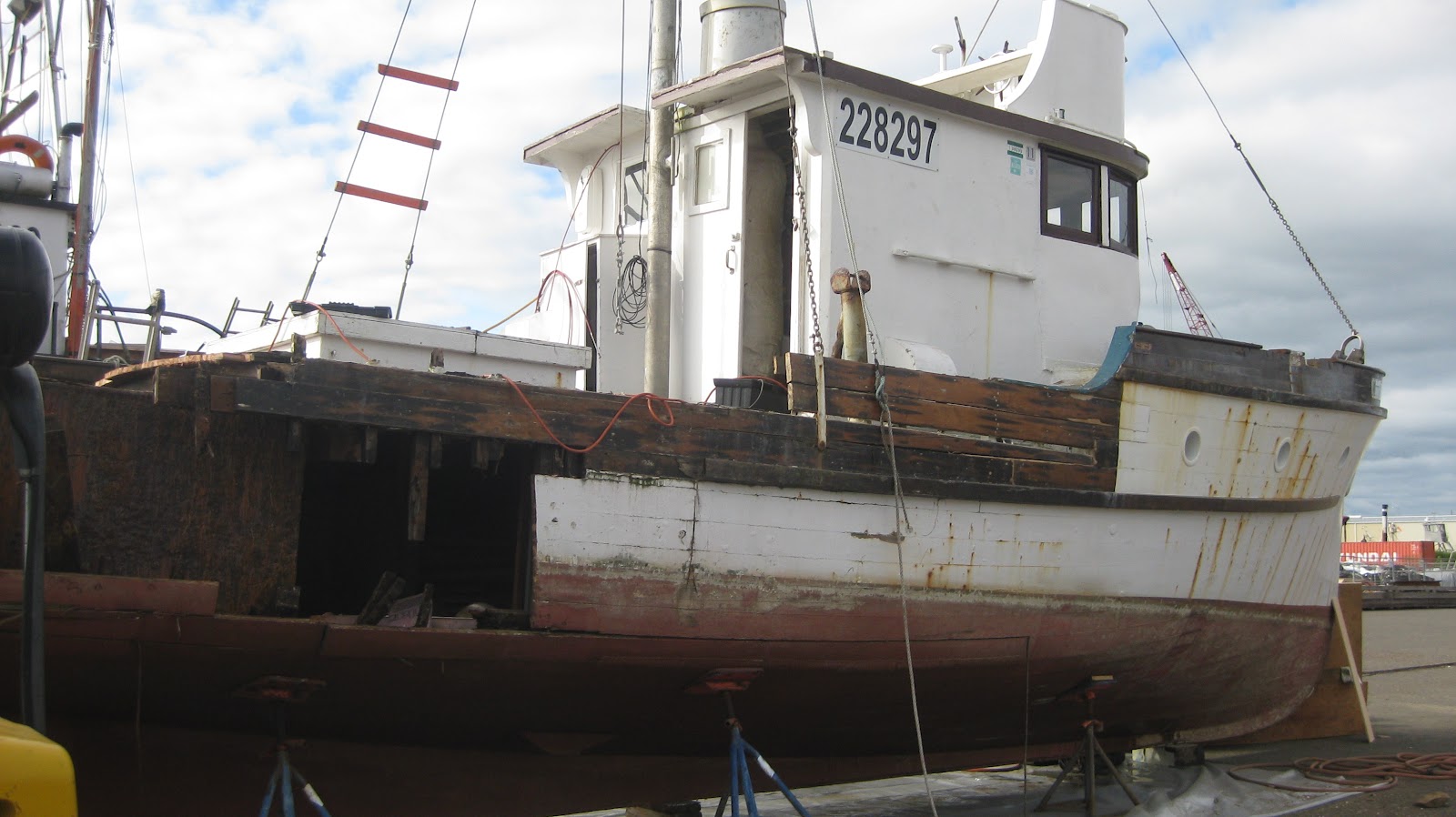
Today Astoria is a small shipping town on the Oregon coast. We walked through the repair yards.

My father identified the boat on the left as homemade.

I believe the owner told us that his Metta Marie, which is now being taken apart, is some 80 years old.


Poor things want to be out sailing, and here they are propped up on land for repairs, looking out to sea.


Ocean-going ships

Monument to the Unknown Whatsit

It really is that green.

Seagull tracks

Nice colors


Astoria is a very old town, and looks it.


It is still wet. But not disagreeable.

18 October 2012

Cathlamet

Cathlamet crops up in the journals of Lewis and Clark as a Chinook town on the Columbia.
Today there is still a Cathlamet - whether in the same place, I couldn't tell ya - on the Washington side.
It looks like Oregon: small wooden houses with leaded windows, from the '30s. This despite the lack of zoning laws, which says a lot about the people of Cathlamet. There are no stoplights in the entire county. There are a lot of lawn ornaments, cast deer predominating.

There is an old hotel, with the lobby on the second floor, whose proprietors took time to shmooze with us. All the people we met are down-to-earth folks who work for the county and fish.
"Would you ever live outside this county?" one of them once asked a young lady of his acquaintance.
"No," she said.
"Will you marry me?" he asked, then. (She said yes.)

Out in the river lies the island half of Cathlamet, Puget Island; and that looks like Washington: massive houses on large lawns, alternating with fields of Holsteins.
The fields are very green, the hills very blue, the sky very grey: the entire county is executed in watercolor.

As always, clicking on pictures will enlarge them.

Raise your hand if you transposed two letters in the name of the boat in the foreground.

I forgot about this local variation on the police car.

This house is pretty typical of the entire mainland Cathlamet.


Doesn't this look like a saloon? --The upper floors are abandoned.
The siding is asbestos.

04 September 2012

Gig Harbor

...but first, Tacoma.


In the family hunt for Charming Towns in Washington, waterfront Tacoma is at a disadvantage: it has gone directly from being a Mill Town to being a Commuter Suburb, without stopping at Charming in between. But they have done some nice things with it: the wreck of the former mill has been covered with gravel, carefully planted with resilient local species, and turned into a lovely park.
After the waterfront, we breezed through without paying due attention to the rest of Tacoma, except to note that the commercial lane just above the waterfront offers the service of about eight lawyers per block.

Gig Harbor is located just across the new Tacoma Narrows Bridge. The footage of the old Tacoma Narrows Bridge, "Gallopin' Gertie", swaying on the day it finally fell apart, is instructive. It is a staple of high-school physics classes.

Gig Harbor is Charming.


The entrance

 Gig Harbor is a natural harbor with a narrow mouth opening into Puget Sound. The town is U-shaped: it has no natural center but the harbor.
Gig Harbor is an honest-to-goodness fishing town, turning gradually into a retirement town. It is unmistakably Washingtonian - unlike Cathlamet, which is undergoing the same transition but which could be mistaken for Oregon.

I liked this statue:


12 August 2012

Scandinavian Festival


Scandinavian Xing
Junction City, OR is a small farming town founded by Scandinavians. Every summer, a very few blocks of it are roped off for the inhabitants of nearby Eugene, and all the small farming towns in the area, to come stroll around in Scandinavian costume and watch demonstrations of Hardanger embroidery and rosemaling.

It is a small festival -- there are no major exhibitions of anything except folk-dancing, which is presented by the local children. Elderly ladies with very blue eyes sit in the shade tatting bookmarks. Elderly men with very Scandinavian faces sit in the shade and look on. One man made dainty bobbin-lace snakes. I saw no identifiable Norwegian costumes -I think most of the folkdrakt was generic- but I did see lots of Vikings, and a diminutive troll casting an admiring eye at the flower-wreath headbands for sale as it fought to keep its glitzy golden slippers on.
I will be a happy girl the day folkdrakt comes into popular fashion -- especially those flower-wreath headbands with ribbons hanging down: very elegant.

We got into a fair amount of "where in Scandinavia are you from?" with the older costumed locals. I had not anticipated that they would have the same curiosity about us: "You look like honest, valid Jews! I always wanted to meet one of you folks. I read the Bible a lot, you know, Abraham, Isaac, and Jacob, so much that I feel like I know 'em."

"Are you Scandinavian?" I asked one younger woman.
"Everyone in Junction City is an honorary Scandinavian for four days," she explained.

"Are you Scandinavian?" I asked another woman.
"No, I'm Jewish," she said.

My family actually is Swedish, but only since the 19th century.

08 August 2012

Cannon Beach

Four-fifths of Oregon is cowboy country, all dry and pastel and sage-dotted, but when most people think of Oregon what they see in their minds is the Willamette Valley, which is green and protected by blue, snow-capped mountains - snoring volcanoes, technically.
And those of us from between the snoring, soaring Cascade Range and the evergreen hills grow up "pitying people who weren't born in a vale", who grow up on a street like Coney Island Avenue in Brooklyn, which you could just roll down forever, with no interruptions in the grid to stop you from rolling off the edge of the world.

So when we drove down to Cannon Beach, I was a bit perturbed to see the ocean looking so very flat. At seven I was taught never to turn my back on the ocean; now it seemed tame and short. Since when are you, beloved Pacific, such a New York avenue, huh?

That might be the nature of this particular beach; or maybe we caught the tide at the wrong time. But the ocean at Cannon Beach was still broad, and impressive, and extremely cold and windy. Cannon Beach has become a bustling little town, but the beach itself is not like the cozy, friendly, pebbly beaches I remember from New Jersey. When you leave the pines and cross the dunes, you leave behind all feelings of civilization.
I remember my grandmother reading a picture-book that mentioned the lonely seacoast of California, and pausing to observe that "Oregon has an even lonelier seacoast." It occurs to me only at this moment that hers was an isolated literary reference: that grown-ups probably do not go about comparing the loneliness of seacoasts the way they compare gas prices.
But, Oregon's is a lonely seacoast.