"Jew Valley is a basin in Lake County, Oregon, in the United States.
Jew Valley was named for a colony of Jewish farmers who settled there in the early 20th century."
(Thanks Wikipedia)
Wait, what? I grew up in Oregon and I never heard of this.
Apparently the colony, founded by 25 families 'including a shochet,' experienced success for a few years before disbanding.
II.
Speaking of utopian Jewish farming communities... there's a new one in the offing:
The "Frum Farm"
I spoke with the family behind it & it seems to be quite a serious endeavor.
III.
Of course, to me one paradigmatic utopian Jewish community that I never got to see (born just slightly too young; nuts!) is Rav Bulman zt"l's kehilla in Migdal haEmek.
Here's one article that mentions it briefly: by Mrs. T. Katz.
IV.
And before that there was Frankfurt.
This is a wonderful, sparkling article about Frankfurt: Hermann Schwab's memoirs
Showing posts with label Pacific Northwest. Show all posts
Showing posts with label Pacific Northwest. Show all posts
16 June 2017


15 October 2015
Art Installation
translation into Chinuk Wawa:
Mitlite nika tumtum siah kimta sun-get-up, pe mitlite nika
siah-siah kopa klip-sun.
Howkwutl nika mukmuk, pe howkwutl mukmuk chaco tsee?
Howkwutl nika mamook huihui nawitka, pe
Tsiyon kow Pil lope, pe nika kow Arav lope?
Klah mahsh konaway kloshe Sfarad, kahkwa
Hyas ticky nanitch polallie kokshut Hyas-Tyee-wawa-Home.
Chinuk Wawa, or 'the Chinook jargon,' evolved in the course of the 19th century as a means of communication between the native peoples of the Pacific Northwest and the "Bostons" who began to move to the area.
It is a characteristic, more or less dying, language of the end of the West of this novel continent.
10 March 2015
Can't Help Lovin' that Carpet...?
The Port of Portland has announced that it will replace the turquoise airport carpet we all grew up with with a new, green one.
Chaos!
Pandemonium!
How can you do this to us!
Exclaimed an entire generation of Oregonians – each of
whom realized only in that moment that there are others who feel an attachment
to the carpet.
The secret is out. It's a social revolution. We are all
gathered round this carpet like a Dead Poets Society; only, the dead poet is a
carpet.
We express our love for the carpet through art: people have
begun making murals, cross-stitch samplers, yarn colorways. There is this
crackling new unity among Portlandians and I'm enjoying every minute of it. But
I keep asking myself why I, and the rest of us, get so emotional thinking about
a carpet.
I suspect it's because we all grew up traversing that carpet
en route to adventure and again to home. When you see the carpet,
you know you are about to embark on a great expedition. And airport walls all
look alike but when you see that carpet again, you know you are about to
come back to people who know and like you.
When you return to PDX after years of wandering in places
where you are known as the Portlander because there are no others, the
carpet is the first thing you see with which you have Portlanderness in common.
When I got older, the whole idea of carpet became really
arresting, coming from Israel's holy white stone floors back to this land of
complications where a person treads on fabric loops. It's so
complicated. It's so extravagant. It's so American.
You can go and travel and see the world and change in a
hundred ways, but the carpet remains constant.
So it is rather a shock to the system that they are replacing
it with something hunter-green and trendy.
Ah, I guess the world is changing that fast, after
all. Everyone stick near the boat.
I love that the first instinct of Portlandians, upon
receiving this jolt, is to make art about it. I admire that the Port of
Portland's response is to give away the carpet for free to the distributors who
will make sure that as many sentimental people as possible get a slice of it.
...And I love that Portland is such a total original that we are all bonding
over a carpet.
10 December 2012


25 October 2012
Astoria
Lewis and Clark headed up the Missouri, looked West, and saw some mountains they expected to reach any day.
The days kept passing and the mountains kept getting bigger, until they reached the foot of the Rockies.
Well, they got over those. And then they looked West, and saw the Cascades.
By the time they got through the Coast Range, they were stuck spending the winter at Fort Clatsop, in what is now Astoria, in the corner of the Ourigan Columbia and the Coast. The journals from that winter are repetitive.
Wet.
Wet and disagreeable.
Cold and wet.
Cold. Disagreeable. Wet.
They wound up eating their tallow candles for lack of meat.
In the Spring they bade Oregon weather good riddance and returned to Missouri.
Today Astoria is a small shipping town on the Oregon coast. We walked through the repair yards.

My father identified the boat on the left as homemade.
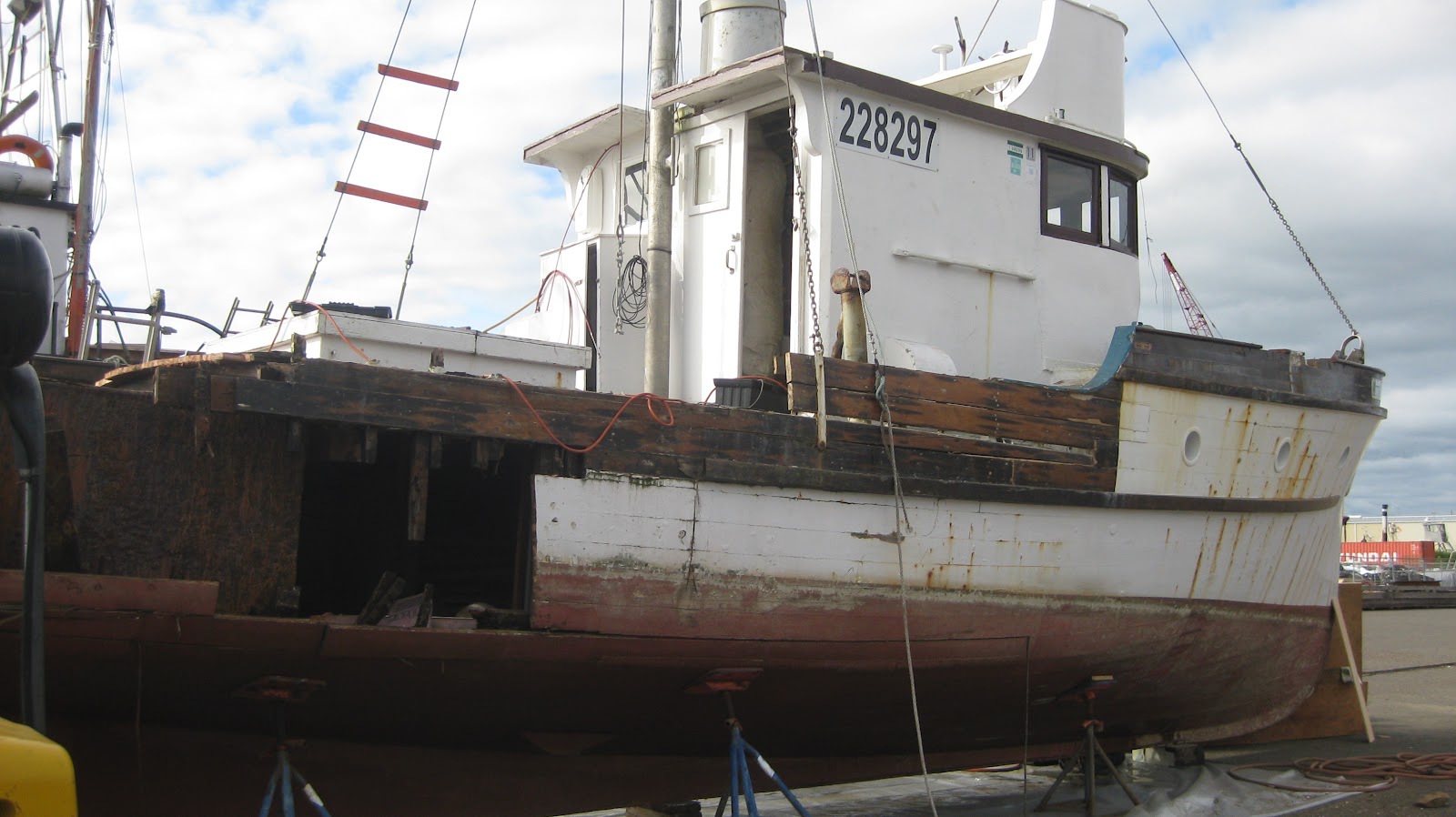
I believe the owner told us that his Metta Marie, which is now being taken apart, is some 80 years old.


Poor things want to be out sailing, and here they are propped up on land for repairs, looking out to sea.


Ocean-going ships

Monument to the Unknown Whatsit

It really is that green.

Seagull tracks

Nice colors


Astoria is a very old town, and looks it.

It is still wet. But not disagreeable.
18 October 2012
Cathlamet
Cathlamet crops up in the journals of Lewis and Clark as a Chinook town on the Columbia.
Today there is still a Cathlamet - whether in the same place, I couldn't tell ya - on the Washington side.
It looks like Oregon: small wooden houses with leaded windows, from the '30s. This despite the lack of zoning laws, which says a lot about the people of Cathlamet. There are no stoplights in the entire county. There are a lot of lawn ornaments, cast deer predominating.
There is an old hotel, with the lobby on the second floor, whose proprietors took time to shmooze with us. All the people we met are down-to-earth folks who work for the county and fish.
"Would you ever live outside this county?" one of them once asked a young lady of his acquaintance.
"No," she said.
"Will you marry me?" he asked, then. (She said yes.)
Out in the river lies the island half of Cathlamet, Puget Island; and that looks like Washington: massive houses on large lawns, alternating with fields of Holsteins.
The fields are very green, the hills very blue, the sky very grey: the entire county is executed in watercolor.
As always, clicking on pictures will enlarge them.

Raise your hand if you transposed two letters in the name of the boat in the foreground.

I forgot about this local variation on the police car.

This house is pretty typical of the entire mainland Cathlamet.


Doesn't this look like a saloon? --The upper floors are abandoned.
The siding is asbestos.
04 September 2012
Gig Harbor
...but first, Tacoma.

In the family hunt for Charming Towns in Washington, waterfront Tacoma is at a disadvantage: it has gone directly from being a Mill Town to being a Commuter Suburb, without stopping at Charming in between. But they have done some nice things with it: the wreck of the former mill has been covered with gravel, carefully planted with resilient local species, and turned into a lovely park.After the waterfront, we breezed through without paying due attention to the rest of Tacoma, except to note that the commercial lane just above the waterfront offers the service of about eight lawyers per block.
Gig Harbor is located just across the new Tacoma Narrows Bridge. The footage of the old Tacoma Narrows Bridge, "Gallopin' Gertie", swaying on the day it finally fell apart, is instructive. It is a staple of high-school physics classes.
Gig Harbor is Charming.


 |
| The entrance |
Gig Harbor is a natural harbor with a narrow mouth opening into Puget Sound. The town is U-shaped: it has no natural center but the harbor.
Gig Harbor is an honest-to-goodness fishing town, turning gradually into a retirement town. It is unmistakably Washingtonian - unlike Cathlamet, which is undergoing the same transition but which could be mistaken for Oregon.
I liked this statue:
I liked this statue:


19 August 2012


16 August 2012


12 August 2012
Scandinavian Festival
Junction City, OR is a small farming town founded by Scandinavians. Every summer, a very few blocks of it are roped off for the inhabitants of nearby Eugene, and all the small farming towns in the area, to come stroll around in Scandinavian costume and watch demonstrations of Hardanger embroidery and rosemaling.
It is a small festival -- there are no major exhibitions of anything except folk-dancing, which is presented by the local children. Elderly ladies with very blue eyes sit in the shade tatting bookmarks. Elderly men with very Scandinavian faces sit in the shade and look on. One man made dainty bobbin-lace snakes. I saw no identifiable Norwegian costumes -I think most of the folkdrakt was generic- but I did see lots of Vikings, and a diminutive troll casting an admiring eye at the flower-wreath headbands for sale as it fought to keep its glitzy golden slippers on.
I will be a happy girl the day folkdrakt comes into popular fashion -- especially those flower-wreath headbands with ribbons hanging down: very elegant.
We got into a fair amount of "where in Scandinavia are you from?" with the older costumed locals. I had not anticipated that they would have the same curiosity about us: "You look like honest, valid Jews! I always wanted to meet one of you folks. I read the Bible a lot, you know, Abraham, Isaac, and Jacob, so much that I feel like I know 'em."
"Are you Scandinavian?" I asked one younger woman.
"Everyone in Junction City is an honorary Scandinavian for four days," she explained.
"Are you Scandinavian?" I asked another woman.
"No, I'm Jewish," she said.
My family actually is Swedish, but only since the 19th century.
 |
| Scandinavian Xing |
It is a small festival -- there are no major exhibitions of anything except folk-dancing, which is presented by the local children. Elderly ladies with very blue eyes sit in the shade tatting bookmarks. Elderly men with very Scandinavian faces sit in the shade and look on. One man made dainty bobbin-lace snakes. I saw no identifiable Norwegian costumes -I think most of the folkdrakt was generic- but I did see lots of Vikings, and a diminutive troll casting an admiring eye at the flower-wreath headbands for sale as it fought to keep its glitzy golden slippers on.
I will be a happy girl the day folkdrakt comes into popular fashion -- especially those flower-wreath headbands with ribbons hanging down: very elegant.
We got into a fair amount of "where in Scandinavia are you from?" with the older costumed locals. I had not anticipated that they would have the same curiosity about us: "You look like honest, valid Jews! I always wanted to meet one of you folks. I read the Bible a lot, you know, Abraham, Isaac, and Jacob, so much that I feel like I know 'em."
"Are you Scandinavian?" I asked one younger woman.
"Everyone in Junction City is an honorary Scandinavian for four days," she explained.
"Are you Scandinavian?" I asked another woman.
"No, I'm Jewish," she said.
My family actually is Swedish, but only since the 19th century.
08 August 2012
Cannon Beach
Four-fifths of Oregon is cowboy country, all dry and pastel and sage-dotted, but when most people think of Oregon what they see in their minds is the Willamette Valley, which is green and protected by blue, snow-capped mountains - snoring volcanoes, technically.
And those of us from between the snoring, soaring Cascade Range and the evergreen hills grow up "pitying people who weren't born in a vale", who grow up on a street like Coney Island Avenue in Brooklyn, which you could just roll down forever, with no interruptions in the grid to stop you from rolling off the edge of the world.
So when we drove down to Cannon Beach, I was a bit perturbed to see the ocean looking so very flat. At seven I was taught never to turn my back on the ocean; now it seemed tame and short. Since when are you, beloved Pacific, such a New York avenue, huh?
That might be the nature of this particular beach; or maybe we caught the tide at the wrong time. But the ocean at Cannon Beach was still broad, and impressive, and extremely cold and windy. Cannon Beach has become a bustling little town, but the beach itself is not like the cozy, friendly, pebbly beaches I remember from New Jersey. When you leave the pines and cross the dunes, you leave behind all feelings of civilization.
I remember my grandmother reading a picture-book that mentioned the lonely seacoast of California, and pausing to observe that "Oregon has an even lonelier seacoast." It occurs to me only at this moment that hers was an isolated literary reference: that grown-ups probably do not go about comparing the loneliness of seacoasts the way they compare gas prices.
But, Oregon's is a lonely seacoast.
07 August 2012


30 July 2012


Subscribe to:
Posts (Atom)